
Quality Policy
At TrustDi, we strive to improve the quality of our discus fish with every breeding cycle. We believe that the quality of our fish should reflect the value of your investment and the time you spend with us. Our Quality Policy serves as a comprehensive guide, detailing how to select discus fish based on observable symptoms and manifestations. This guide includes clear explanations of causes and detailed illustrations for your better understanding.
The content in our Quality Policy outlines the criteria we have developed from our many years of experience and knowledge. These criteria help us classify the quality of the fish we sell to you.
Nine Main Aspects of Quality:
Each aspect is divided into two sections: "What to Choose" and "What to Avoid". These sections provide specific explanations and illustrations of symptoms or manifestations that indicate good or poor quality discus fish, making it easier for you to understand.
Objectives of Our Quality Policy:
TrustDi hopes that with a clear and transparent description of quality, you will be able to limit risks when buying discus fish, increase their survival rate, and ensure your profitability.
Understanding the Causes of Poor Discus Quality:
Our experience has shown that the quality of discus fish can be compromised by various factors, which we classify into three main categories:
1. Illness: When fish are sick, they exhibit external symptoms observable with the naked eye. Common diseases include Hole-in-the-Head (HITH or Hexamita), Gill Flukes, Cloudy Eyes, Fin Rot, and more.
Please Note: The disease manifestations described in this Quality Policy are those visible to the naked eye. These symptoms may indicate that the diseases have passed the incubation period and are actively showing
2. Congenital Defects Due to Genes or Genetic Factors: The quality of discus fish significantly depends on the genetic quality of their parents. Issues may arise from inbreeding, inherited genetic defects, or characteristics inherent to certain fish lines
3. Poor Environmental Conditions: Discus fish raised in suboptimal environments—such as dirty water with impurities, fish feces, decomposed organic matter from food, lack of oxygen, excessive light, aggressive tank mates, or overcrowding, and more tend to have poor quality.
Criteria Based on 9 Main Parts
1. Gills and Breathing

A. What to Choose:
1. Well-formed Gills:
-
The gills should be beautiful and perfectly formed with no abnormalities.
-
The operculum (gill cover) should be smooth, flush with the body, and properly closed.
2. Symmetrical Movement:
The gill covers should move symmetrically on both sides, indicating good respiratory health.
3. Breath:
Healthy gills should move evenly, with about 60-80 openings and closings per minute.
B. What to Avoid:
1. Deformed Gill Covers:
-
Avoid fish with gill covers that are deformed, such as those that are short or warped
-
Gill covers that cannot cover the entire gill area are also signs of poor health or genetic defects.
2. Exposed Gill Tissue:
When breathing, the inside of the gills should not be exposed. If the gill tissue is visible, it may indicate poor water quality or poor farming conditions. For example, if the water lacks oxygen or the fish has been living in dirty water for a long time, the fish will have to work harder to breathe, and over time, their gills will become increasingly opened.
3. Accelerated Breathing:
Rapid gill movement (more than 80 openings and closings per minute) can indicate problems with the pH level, temperature, or organic pollution in the water.
Avoid fish that show signs of heavy breathing or one-sided gill breathing. Rapid gill movement under normal conditions can specifically indicate problems if:
-
The water parameters have recently changed, such as new water, altered pH, or changes in oxygen levels. Fish may breathe faster due to being moved to a new tank leading to stress. In such cases, this is usually not a concern, and their breathing should return to normal within a few hours.
-
If the living environment is stable and the fish still exhibit rapid or heavy breathing, this could be a sign of genetic abnormalities, gill diseases, oxygen problems in the water, or poor water quality.
2. Body Shape and Head Form

We classify body shapes into three main types: round shape, high body, and long shape. When evaluating body shape, we consider it alongside the head shape to assess the overall form of a discus.
A. What to Choose:
1. Round Shape with Slightly Curved Head:
-
The ideal discus should have a round body shape. A well-proportioned body with a smooth, rounded outline is preferred.
-
The head should have a slight, natural curve that blends seamlessly with the body. A continuous curve from the forehead to the body is ideal.
2. High Body:
Modern strains often exhibit a high body shape, which is desirable if the head is slightly curved and well-proportioned.
3. Symmetrical Body viewed from the Front:
When viewed from the front, a discus fish should have a symmetrical body, with the left and right sides mirroring each other. Imagine drawing a vertical line down the center of the fish; both sides should be evenly balanced and identical in shape and size.
B. What to Avoid:
1. Long Body with a pointed (V-shaped) head:
-
Avoid discus with an elongated body shape, as this is less desirable. Discus with an elongated body shape and a pointed (V-shaped) head are often not considered aesthetically pleasing.
-
Additionally, an elongated body shape can be a sign of malnutrition, especially when combined with other information about the rearing conditions.
Please Note: When discus are young, about 1-1.5 inches in size, they will have an elongated shape, not the round shape you often see when they are adults. To be sure of their shape, you need to wait until they reach at least about 2 inches in size to determine their body form.
2. Deformities
2.1. Due to Genes: Curved Body Viewed from the Front:
Discus with visible spinal deformities like scoliosis (curved spine) or lordosis (swayback) should not be selected. These deformities are noticeable when looking from the front; a straight-on view will show that their bodies are curved.
2.2. Due to Diseases: Hole-in-the-Head (Hexamita):
Any noticeable deformities such as bumps or dips. One common issue is Hole-in-the-Head disease, which appears as sores on the head and should be carefully monitored.
3. Eyes

A. What to Choose:
1. Clear and Bright Eyes:
The eyes should be clear and bright. Healthy eyes typically stand out and are lively in appearance.
2. Proportional to the Body Size:
-
The ideal eye-to-body ratio for discus fish is about 1:7. This means the length above the eye should be three times the eye size, and the length below should also be three times the eye size. Some modern strains, like high body discus fish, may have a ratio of 1:9.
-
If the eyes are too large compared to the body, it indicates stunted growth or uneven development, which is not desirable. Avoid selecting fish with an eye-to-body ratio larger than 1:7.
It's important to look at the overall shape and proportion of the fish to assess its health and growth potential. Discus fish that are round, well-proportioned, and do not have disproportionately large eyes are generally considered to have good growth potential.
3. Uniform Size with Both Eyes:
Both eyes should be of equal size and not uneven. Symmetry in eye size is crucial for selecting a beautiful discus.
B. What to Avoid:
1. Cloudy Eyes:
-
Cloudy Eye is a prevalent condition affecting discus fish, characterized by a white film or milky sheen covering one or both eyes.
-
This condition can result from various factors, including poor water quality, immune system disorders, stress, malnutrition, and improper medication use. Based on TrustDi’s experience, Cloudy Eye can arise from the overuse of medications, especially after prolonged treatments for skin fungus in discus fish, suggesting it as a possible side effect of such treatments.
-
Identifying and addressing the root cause is crucial for effective treatment. Maintaining clean water, ensuring proper nutrition, and monitoring tank conditions are essential steps in preventing and managing this condition.
2. Popped or Bulging Eyes:
Pop-Eye, medically known as exophthalmia, is a condition where a fish's eye swells and bulges abnormally from its socket. This can affect one or both eyes and is often a symptom of an underlying illness or infection. Common causes include bacterial infections, poor water quality, injuries, and other environmental factors. If left untreated, Pop-Eye can lead to severe complications, including blindness and even death. Early diagnosis and proper treatment are crucial for the successful recovery of affected discus fish.
3. Large Eyes:
Eyes that are too large relative to the body size suggest that the fish may be stunted or underdeveloped. While their eyes continue developing, their bodies may stop growing due to malnutrition or disease, resulting in disproportionately large eyes. Avoid fish with a disproportionately large eye size compared to the body.
4. Uneven Eye Size:
Fish with one eye noticeably larger than the other should be avoided. This asymmetry is often a genetic defect and can indicate poor overall health.
5. Deformed Eyes:
Fish with deformed, dented, or irregularly shaped eyes are often considered unsightly. These defects are usually genetic rather than disease-related and, therefore, do not affect the health of the fish. However, they do impact the fish's aesthetics.
4. Skin Color
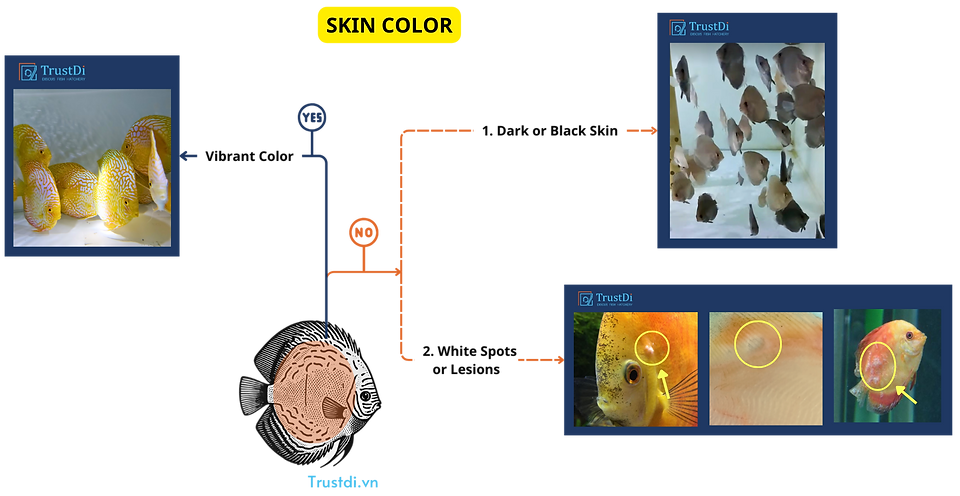
A. What to Choose:
Vibrant Color:
Choose discus fish with vibrant, consistent colors. The color should be vibrant and consistent for the specific discus strains, reflecting good health and proper care.
PLease Note: While color can be a major attraction, it should not be the primary criterion for selecting discus fish, especially young ones, as their colors develop fully only as they age. In some strains, juvenile discus do not show their full coloration until they are about a year old. Thus, while selecting young discus, ensure overall health is prioritized over color.
B. What to Avoid:
1. Dark or Black Skin:
-
Avoid discus with black or excessively dark skin, as this can be a sign of stress, illness, or poor water conditions. Discus displaying these colors are often experiencing health problems.
-
Additionally, you can easily detect these fish by paying attention to those that separate from the school to lie alone in a corner. They may appear sluggish and rest on the bottom or against the wall.
2. White Spots or Lesions:
-
White spots, circles, scratches, or scars on the skin are indicators of illness or injury. These can be symptoms of parasitic infections, bacterial infections, or other health issues.
-
When the body of the discus you intend to buy shows scratches or skin damage, but they still appear healthy, active, and hungry, most of them can still be treated without causing side effects on the digestive system when using medications or leaving scars on the fish's body. However, if not treated early, they may die, or if they survive the disease, the infected areas will leave scars, reducing the aesthetics and value of the fish.
-
Furthermore, if you are a discus fish importer, the shipping time will take many days. If the fish were previously infected with fungus, it is very likely that they will die during transit or spread the infection to other fish.
Therefore, we encourage you not to buy fish that show signs of lesions, white spots, or white patches on their bodies.
5. Pectoral Fins and Caudal Fin

A. What to Choose:
1. Clear and Intact Fins:
The fins should be clear and free from any discoloration, sores, or damage. Healthy fins are transparent or have a consistent color that matches the overall coloration of the fish.
2. Extended and Spread Fins:
The fins should be fully extended and spread out, showcasing the fish's natural beauty and health. Fins that are held close to the body or appear clamped can be a sign of stress or illness.
B. What to Avoid:
1. Signs of Disease or Infection:
Look out for signs of diseases such as fin rot, which can cause the fins to appear ragged, discolored, or eroded. Ensure there are no visible signs of fungal or bacterial infections on the fins or tail.
2. Clamped Fins and Tail:
Clamped fins, where the fins are held tightly against the body, are a sign of stress or illness. Discus with clamped fins may be suffering from poor water conditions or underlying health problems.
3. Peppering:
-
What to Avoid: Heavily peppered fins and tail should be avoided. This peppering often indicates poor breeding practices and can be a sign of inferior genetic quality.
-
Acceptable Amount: A small amount of peppering can be normal in some strains, but excessive peppering, particularly in strains that are not known for this trait, should be avoided.
Please Note: Peppering is more common in pigeon discus strains. Therefore, when selecting breeding fish, pay attention to the parent fish to limit peppering. Additionally, the breeding environment also affects whether peppering appears or not.
6. Dosal and Anal Fins

A. What to Choose:
1. Well-Formed Fins with Intact Edges:
-
The dorsal and anal fins should be symmetrical and proportionate to the overall shape of the fish. These fins contribute significantly to the discus's body shape, so they should be well-formed and free of any deformities.
-
The fins should be fully extended, vibrant in color, and have smooth, intact edges without any signs of fraying or damage.
B. What to Avoid:
1. Frayed or Damaged Fin Edges:
Avoid fish with fins that have frayed, ragged, or torn edges. This could indicate that the fish has been kept in overcrowded conditions or in an environment where they frequently bump into tank decorations or other fish, leading to injuries that worsen over time.
2. Clamped Dorsal and Anal Fins:
Fish with clamped fins—fins that are not fully extended—are likely suffering from a fungal infection or another illness. Clamped fins are a clear sign that the fish is not in good health and should be avoided.
7. Fecal Matter

A. What to Choose:
Dark or Black Colored Feces:
-
Fecal matter should be dark in color, usually black, indicating a healthy digestive system. The dark color suggests that the fish is properly digesting its food and absorbing nutrients effectively.
-
The feces should be compact and have a consistent texture, indicating that the fish is not experiencing digestive issues or internal parasites.
-
Healthy discus fish will have regular bowel movements. Observing the fish and noting regular defecation can be a sign of good health and a properly functioning digestive system.
B. What to Avoid:
White, Clear, or Yellow Feces:
If you observe fish feces that are white, clear, or yellow, this can be a sign of internal parasites, infections, or poor nutrition. Avoid purchasing fish that consistently produce white or clear feces, as this can indicate underlying health issues.
8. Behavior and Activity

A. What to Choose:
1. Active and Energetic:
-
Healthy discus fish are generally active and swim around the tank confidently.
-
They should explore their environment and show interest in their surroundings.
2. Curiosity:
-
Discus fish should display curiosity, approaching the front of the tank or reacting to movements outside the tank.
-
Fish that follow your hand movements or come to the surface when you approach are usually healthy and well-adjusted.
3. Good Appetite:
-
Healthy discus fish have a strong appetite and actively come to feed during feeding times.
-
They should be eager to eat and compete for food with other fish in the tank.
4. Social Behavior:
-
Discus are social fish and should be seen interacting with other discus.
-
They should swim in groups and not isolate themselves from the rest of the tank inhabitants.
5. Smooth and Coordinated Movements:
-
The fish should move smoothly and gracefully without any signs of erratic swimming or difficulty in maintaining balance.
-
Their movements should be fluid, and they should not appear to struggle while swimming.
B. What to Avoid:
1. Lethargy or Inactivity:
-
Discus fish that are lethargic, remain stationary for long periods, or show little interest in their environment may be unwell.
-
Avoid fish that appear to be resting at the bottom of the tank or hiding excessively.
2. Isolation:
-
Fish that isolate themselves from the group and hide frequently may be experiencing stress or illness.
-
Avoid discus that consistently stay away from other fish or hide behind decorations.
3. Erratic Swimming:
-
Fish that swim erratically, have difficulty maintaining balance, or exhibit unusual swimming patterns may have neurological or health issues.
-
Avoid fish that dart around the tank, swim in circles, or appear disoriented.
4. Lack of Response to Food:
-
Discus fish that do not respond to food or show little interest in feeding may be experiencing stress, illness, or internal problems.
-
Avoid fish that do not actively participate during feeding times or ignore food.
9. Environmental Conditions

A. What to Choose:
Clean Tank:
-
The tank should be clean and well-maintained, without a strong fishy or unpleasant smell.
-
Water should be clear, free of debris, and have minimal algae growth.
B. What to Avoid:
1. Dirty Water:
Avoid tanks with dirty, cloudy, or murky water, as this indicates poor water quality and maintenance. Water is often dirty due to the following factors:
-
Water is not changed regularly, even if the fish are fed little.
-
Water is cloudy and dirty due to leftover food that has decomposed for a long time but has not been cleaned.
-
Water has a strange color such as yellow, orange,…. This can be a sign that the fish are treated with medication. While medicated water does not necessarily mean the fish are sick, sick fish will definitely need to be treated with medication.
Therefore, ask the seller if you see the fish you are buying in a tank of medicated water.
2. Bubbles on the Water Surface:
If you see a lot of bubbles appearing and floating on the water surface, these bubbles are often difficult to dissolve and come with a fishy smell that makes you nauseous. These may be symptoms of fin rot in fish.
3. Strong Fishy Smell:
Usually, fish tanks will have a fishy smell, but it should be very faint and not strong enough to make you uncomfortable. Pay attention to tanks with a strong fishy smell, as they may contain ill fish.